Car Down Payment vs Full Loan: Smarter Way to Buy
By AdityaSeptember 18, 2026
Key Takeaways
- Choosing between car down payment vs full loan comes down to monthly EMI calculation, total interest payout, and liquid cash flow.
- A larger car down payment means a smaller loan borrowed. This keeps monthly EMIs easy to manage while reducing the final interest paid.
- 100% funding for a new car makes sense if you are saving cash for other emergency expenses or want to invest in a high-yielding financial instrument that is likely to outgrow the car loan interest rate.
How Car Down Payment vs Full Loan Impacts Your EMI
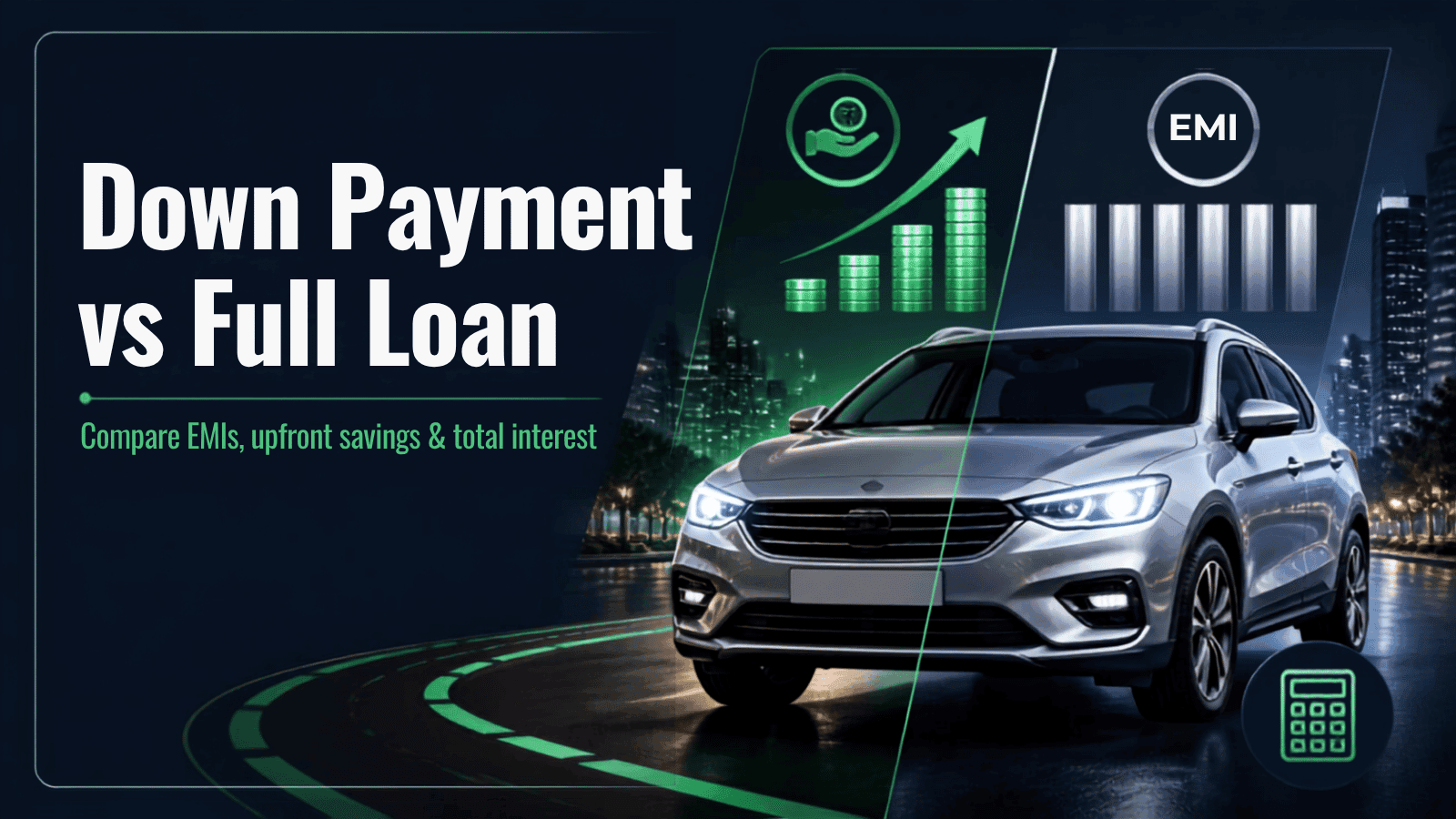
When buying a car, a larger down payment reduces the principal loan amount, keeping your monthly EMIs low. This also reduces the total interest paid over the loan tenure. Take an example of a car with an on-road price of ₹10 lakh, financed over a 7-year tenure at a 9% interest rate per annum (SBI car loan interest rates range from 8.40% to 9.35% p.a.). Compare two scenarios where you make a 10% down payment and a larger 30% down payment to see how much your monthly EMIs will come to, and how much car loan you will have to take.
| Particulars | 10% Down Payment | 30% Down Payment |
| Car price | ₹10,00,000 | ₹10,00,000 |
| Down payment | ₹1,00,000 | ₹3,00,000 |
| Loan amount | ₹9,00,000 | ₹7,00,000 |
| Interest rate | 9% p.a. | 9% p.a. |
| Loan tenure | 7 years (84 months) | 7 years (84 months) |
| Monthly EMI | ₹14,480 | ₹11,262 |
| Total of 84 EMIs | ₹12,16,334 | ₹9,46,000 |
| Total interest paid | ₹3,16,334 | ₹2,46,000 |
| Total cash outflow including down payment | ₹13,16,334 | ₹12,46,000 |
While choosing a 30% down payment requires you to pay ₹2 lakh more upfront, it significantly lowers your monthly EMI payout by ₹3,218 and saves you approximately ₹70,334 on the overall interest paid at the end of the 7-year tenure.
The figures may change slightly depending on the actual car price, selected tenure and rate of interest offered by your bank, but the idea remains the same. Larger down payment = lower loan amount, reduced monthly EMIs and total interest paid.
For a broader explanation, find out how a Car Loan EMI Calculator works.
When a Bigger Car Down Payment Makes Sense Over a Full Loan?
While buying your first car, putting down a larger amount upfront is a smart move if you have enough savings and want to reduce your monthly EMI burden.
- You want to keep your monthly EMIs manageable and have enough cash flow for other expenses, such as fuel costs, routine maintenance, and annual insurance.
- You want to lower the total interest payable at the end of the repayment cycle.
- You want to avoid negative equity. Since new cars lose value in the initial years, a substantial car down payment prevents your outstanding loan balance from exceeding the vehicle’s market value.
- You want better loan terms and easy approvals. Lenders see buyers making a larger car down payment as low-risk applicants (low Loan-to-Value ratio), prompting them to offer you better interest rates and lower overall loan costs.
When Choosing a Full Loan Is Better Than a Large Car Down Payment?
Financing your first car, or at least a large portion of it, makes sense if your top priority is preserving cash for contingencies rather than minimizing final loan interest.
- If you want to preserve cash or build an emergency fund rather than splurge all your savings on a car purchase.
- If you want to put your money in a high-yielding investment option, such as an equity mutual fund, expecting its average returns to exceed the loan interest rate.
- If you want to leverage subsidized interest rates offered by the manufacturer. Major car brands often tie up with banks and NBFCs to offer promotional low-interest schemes, making borrowing cheaper.
- If you want to buy a car immediately without waiting for months to save up cash.
What Lenders Expect Upfront When Comparing Car Down Payment vs Full Loan?
Most banks and NBFCs evaluate car loan applications based on the regulatory guidelines framed by the Reserve Bank of India. Although some banks do finance 100% of the car’s ex-showroom price for select salaried customers (depending on credit rating, income-to-debt ratio, LTV, etc.), you still need to cover mandatory out-of-pocket costs.
Historically, SBI’s Auto Loan MITC guidelines mentioned the bank financing a maximum of 85% LTV on a vehicle’s on-road price, while buyers had to cover the remaining 15% as a down payment. But now, SBI offers a full loan (100% of the on-road price) to its most valued customers on purchasing some select car variants.
Similarly, HDFC Bank offers its first-time car buyers up to 100% funding on the on-road price of Toyota Cars through digital schemes, like the Xpress Car Loan program.
How Should First-Time Buyers Compare a Car Down Payment vs Full Loan?
Deciding between car down payment vs full loan requires balancing the total cost of borrowing with the amount of cash you need to retain. A smarter approach is to calculate both scenarios using the same car, loan tenure and interest rate (shown in the table above). Compare how much EMI you would be paying every month, how much car down payment you would need to make upfront, and what the cumulative interest would turn out to be at the end of the loan lifecycle.
Once you have the car down payment finalized, check how much money you would be left with. This is important because a lower EMI doesn’t necessarily mean a better financial outcome if the purchase leaves you with little cash in hand.
First-time buyers should also compare the complete car loan terms, processing fees, documentation charges, prepayment or foreclosure charges and conditions.
Frequently Asked Questions (FAQs)
Is a full loan more expensive than making a car down payment?
While 100% funding seems an easier option than depleting your savings on purchasing a car, it often turns out expensive when you calculate your monthly EMIs and the final interest payout at the end of the loan tenure. Thinking about the long term, taking a full loan may actually turn out to be more expensive than paying a certain amount upfront.
How much should I put down on my first car?
Making a 10-30% down payment on your first car is generally acceptable if you want to keep your EMIs manageable without spending a huge sum upfront. The car down payment amount depends on the tenure and rate of interest. The best approach is to compare the monthly EMI and overall interest against the amount of money you would save after making a car down payment.
Is 0% down payment financing genuinely cost-free?
Although a 0% down payment finances the car’s purchase price, it does not include registration fees, RTO charges, road taxes, and initial insurance costs. You need to pay these charges out of pocket.
Does paying a larger car down payment reduce my annual insurance premium?
A car loan down payment does not cover your annual insurance premiums. The car insurance premium is determined based on the vehicle’s Insured Declared Value (IDV), model, and other add-on covers, and needs to be paid separately.
What is the smartest way to pay for a new car?
The smartest way to pay for a new car is to make a 20% down payment in cash and finance the rest with an affordable 5-year loan, which ensures lower monthly EMIs and total interest payout.