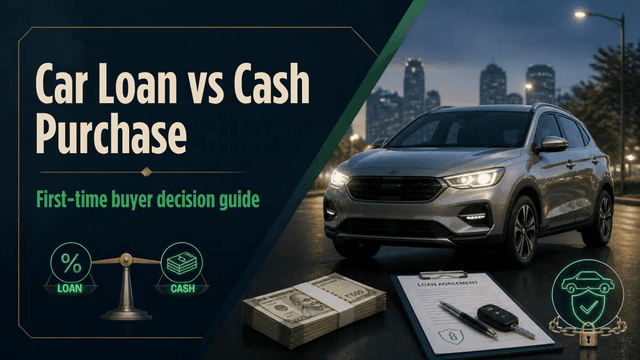
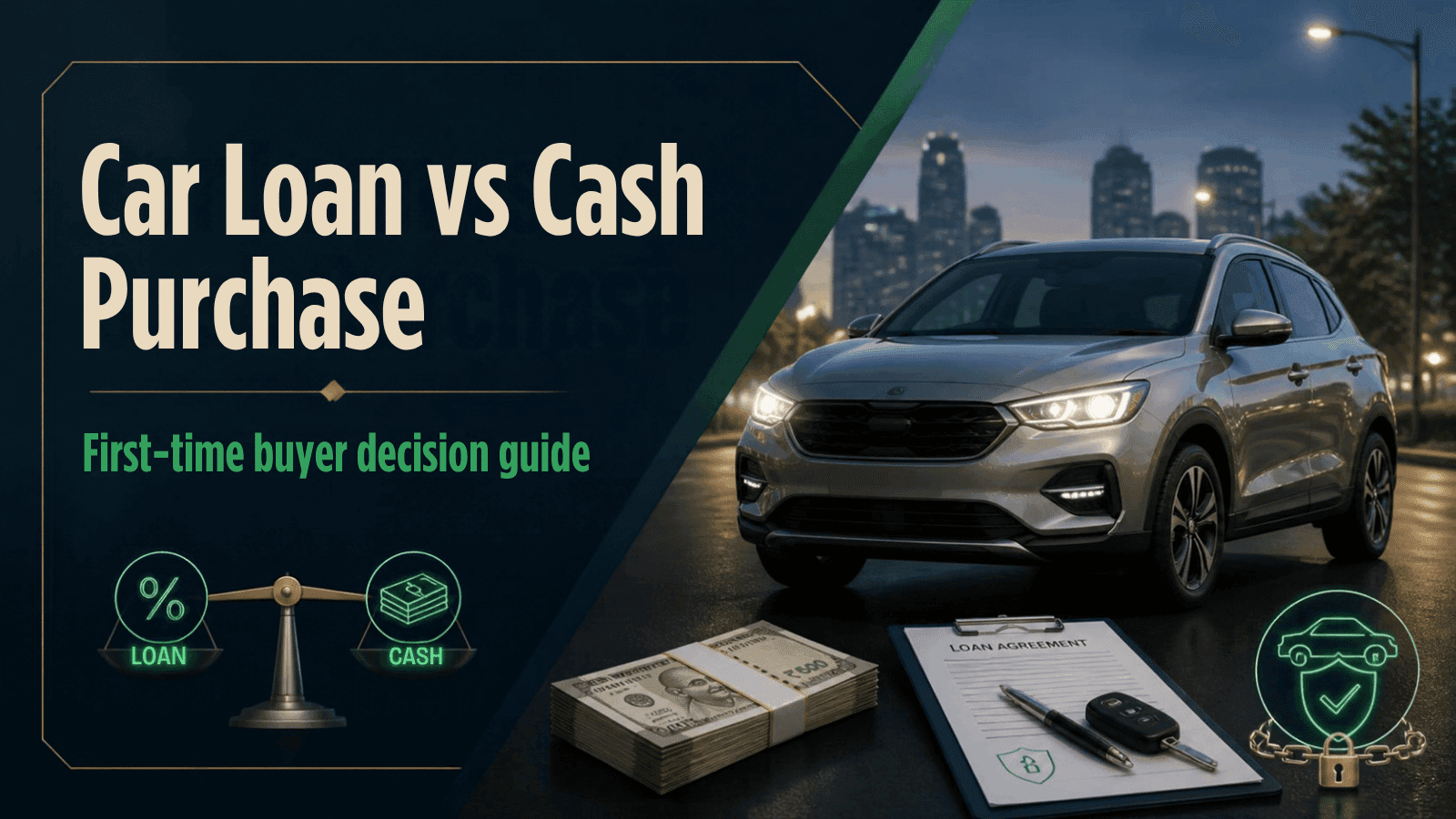
Car Loan vs Cash Purchase: First Time Buyer Decision Guide
By AdityaOctober 2, 2026
Key Takeaways
- Making the right choice between a car loan vs cash purchase can ease your experience as a first-time buyer. Key factors to evaluate include your final interest costs, liquidity and emergency funds, and hypothecation/ ownership rules.
- A cash purchase saves you from high interest rates, recurring monthly EMIs, and hypothecation. But it dips into your hard-earned savings as you pay 100% of the vehicle’s on-road price out of your own pocket.
- A car loan preserves your bank balance for unexpected expenses or medical emergencies. You can either finance 100% of the on-road price or pay a small down payment as per convenience. But this also means paying a standard-to-high interest rate (typically starting at 8.15%) and a higher total interest outlay at the end of the tenure.
- Financed cars hypothecated to the bank require an NOC, RTO Form 35, registration certificate, PUC certificate and valid insurance policy to obtain a clean ownership title after the loan repayment.
What Is the Real Financial Difference Between a Car Loan vs Cash Purchase?
Buying a car in cash makes sense when the purchase doesn’t deplete all your savings and leave you without a reserve for unexpected expenses. As a first-time buyer, calculate what you'll have left after paying for the car. The balance should ideally cover your likely expenses and a contingency fund based on your current circumstances.
A car loan certainly preserves a larger portion of your savings, as you only pay a specific amount upfront. But the retained amount goes into paying monthly EMIs and total interest costs at the end of the loan tenure. Besides, when you take a car loan, the vehicle becomes hypothecated, meaning it serves as collateral and the lender holds ownership rights until the loan is repaid.
So, the decision between a car loan vs cash purchase comes down to evaluating your current liquidity, total interest payout, and long-term investment returns.
Comparing Car Loan vs Cash Purchase
| Core Parameters | Full Cash Purchase | Car Loan Financing |
| Initial Cash Outlay | 100% of the on-road price | 10%–20% down payment (or up to 100% on-road funding) |
| Interest Charges | ₹0 | 8.40%–10.25% p.a. (based on credit score) |
| Mandatory Bank Fees | ₹0 | 0.5%–2% processing fee, documentation fees, stamp duty |
| Vehicle Title Status | Clean ownership title under your name | Hypothecated to the lending bank until final EMI clearance |
| Emergency Fund Impact | High initial liquidity depletion | Low initial cash depletion; preserves emergency reserves |
| Ownership Transfer Ease | Direct RTO transfer anytime | Requires bank No Objection Certificate (NOC) and Form 35 |
Let’s say you want to purchase a car worth ₹10 lakh. Paying the whole amount in cash would rid you of the monthly EMI burden and cumulative interest. But if you choose to make a 20% down payment (₹ 2 lakh) and finance the remaining ₹ 8 lakh for 7 years at an 8.15% interest rate per annum, then you would have to pay an EMI of ₹12,529 every month. At the end of the tenure, your total interest payable would stand at ₹2,52,423, and the final amount payable would be ₹10,52,423 (excluding processing fees and other documentation charges).
Key Factors to Consider Before Choosing a Car Loan vs Cash Purchase
Before deciding on whether you want to go for a car loan vs cash purchase, evaluate immediate cash reserves, total interest and acquisition costs, investment opportunities, and vehicle hypothecation rules.
Total Interest Burden and Acquisition Cost
- Bank Interest Rates: Car loan interest rates vary by the lender. While public banks like SBI charge 8.40% to 9.35% p.a., private banks such as ICICI or HDFC typically levy 8.15% to 10.25%, depending on your credit history. The higher the interest rate, the higher your total interest cost will be at the loan tenure expiry.
- Interest Payout Breakdown: Borrowing a car loan amount of ₹ 8 lakh for 7 years at 8.15% interest leads to a total interest amount of ₹ 2.52 lakh. This means approximately 24% of your total loan outlay is the cost of borrowing alone, rather than the value of the car itself.
- Processing and Documentation Fees: Banks charge an additional, non-refundable 0.5% to 2% of the loan amount as processing fees, along with stamp duty and documentation charges.
- Advantage of Cash Purchase: Cash payment eliminates all the interest charges, EMIs and borrowing costs, ensuring you get the lowest possible total cost of ownership.
Liquidity Protection and Emergency Funds
- Capital Erosion: Paying in full with cash can exhaust your savings and leave you vulnerable to sudden financial crises or medical emergencies.
- Investment Opportunity Cost: Investing in high-yield funds or fixed deposits can fetch higher returns and can be used to offset your overall borrowing costs.
- Emergency Fund Threshold: A cash purchase is highly recommended only if you have at least 6 months of financial backup for regular expenses and emergencies.
Hypothecation and Legal Registration Rules
- Registration Certificate Endorsement: A car bought on loan gets a “Hypothecated to…” endorsement on the registration certificate. This gives the lender a legal claim to the car as collateral until the loan is paid off.
- Hypothecation Removal Fees: To remove the hypothecation at your local RTO after the loan is repaid, you would have to submit Form 35, the NOC, the original registration certificate, alongside a valid insurance and Pollution Under Control (PUC) certificate, and pay a standard RTO processing fee of roughly ₹100 to ₹500.
- Loan Payoff Documentation: Following the loan repayment, you would require an NOC and two signed copies of RTO Form 35 from the lender.
- Resale Flexibility: Cars via cash purchase carry clean ownership titles from the very first day, so you can transfer ownership or sell them off if needed, without intervention from the bank.
When to Choose a Car Loan vs Cash Purchase?
Choosing between a car loan vs cash purchase depends on your income stability, liquid reserves, and current credit profile. A cash purchase could be a smart choice if you have a solid financial backup covering at least 6 months of your lifestyle expenses, prefer absolute legal ownership from Day one, and want to avoid monthly EMI commitments.
If you want to reserve cash for emergency expenses, want to build a strong credit history, and prefer smaller, manageable monthly payouts rather than a lump sum, then taking a car loan is the better option.
FAQs
Does paying full cash for a car lower my insurance premium?
No, a cash purchase does not directly lower your base insurance premium. According to IRDAI regulations, insurers calculate premiums based on the car’s IDV, age and model, cubic capacity, driving record, and chosen add-ons, regardless of whether you opt for a car loan vs cash purchase.
What is the standard tenure for a new car loan in India?
Most banks and NBFCs offer a standard car loan tenure spanning from 1-7 years (12-84 months).
Can I pre-close my car loan early to save on interest?
Yes, most lenders allow you to close your car loan after an initial mandatory lock-in period of 6 months. While public banks usually do not charge any penalties for loan foreclosure, some private banks may charge a nominal 3-5% penalty fee on the original loan principal.
How long is a bank NOC valid for RTO hypothecation removal?
A bank NOC for hypothecation cancellation remains valid for 90 days from the issue date. You must submit the NOC, along with Form 35, to your local RTO within the 3-month period.
Should first-time buyers avoid car loans?
The decision between a car loan vs cash purchase for first-time buyers depends on immediate savings, income stability, EMI affordability, and long-term interest costs. If you have sufficient cash in reserve and want to skip unnecessary interest and EMI burden, then a full cash payment makes sense.