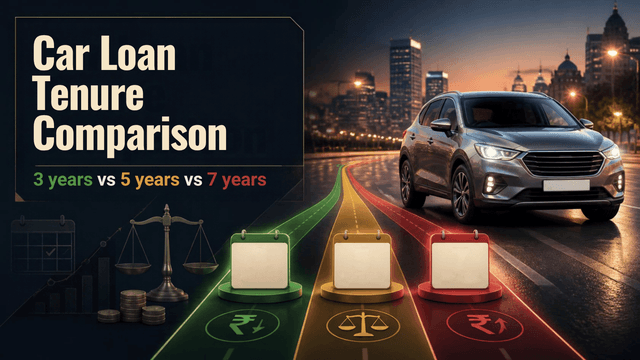
Car Loan Tenure Comparison: 3 Years vs 5 Years vs 7 Years
 By Anjani ChaandOctober 5, 20266 min read
Key Takeaways
- Car loan tenure comparison shows that a shorter repayment period, such as 3 years, reduces the total interest paid at the end. On the downside, it requires you to pay much higher monthly installments. This timeline works well for high-income groups who want to repay a car loan faster and avoid massive interest costs.
- With a 5-year loan tenure, you can comfortably manage monthly EMIs without straining your budget, while also keeping your total interest costs well within limits.
- A 7-year loan tenure substantially increases the final interest payable, but you get to make smaller EMI payments every month. This is particularly suited for buyers who don’t want to compromise on their immediate monthly budget for EMIs.
What Is the Best Choice in a Car Loan Tenure Comparison?
The best choice in a car loan tenure comparison depends on how well you balance your monthly budget against total interest costs. A shorter 3-year loan tenure keeps your total interest lowest but requires significantly higher monthly EMI payments. A longer tenure, such as 7 years, reduces the monthly installment burden but drastically increases the overall interest payable.
For most first-time car buyers in India, a 5-year loan tenure is the standard benchmark. It helps you manage your monthly EMIs while keeping the cumulative interest reasonable.
Let’s take an example: You take a loan of ₹8 lakh at 8.70% interest p.a. to purchase a new car. Here’s what your monthly EMIs, total interest and final repayment amount would look like over a 3-year vs 5-year vs 7-year car loan tenure comparison.
| Loan Tenure | Monthly EMI | Total Interest Payable | Total Cost (Principal + Interest) |
| 3 Years (36 Months) | ₹25,328 | ₹1,11,816 | ₹9,11,816 |
| 5 Years (60 Months) | ₹16,490 | ₹1,89,427 | ₹9,89,427 |
| 7 Years (84 Months) | ₹12,750 | ₹2,70,983 | ₹10,70,983 |
The above calculations exclude processing fees, stamp duty, and documentation charges.
Car Loan Tenure Comparison Parameters: 3 Years vs 5 Years vs 7 Years
The tenure of a car loan comparison over 3, 5, and 7 years affects your monthly repayment and the total interest you pay. While a shorter period means higher EMIs and lower interest, a longer period results in smaller installments and higher interest costs. A 5-year period is ideal, with moderate interest and balanced EMIs.
A 3-Year Car Loan Tenure Minimizes Interest, Maximizes Monthly Outflow
- Lowest Total Interest: A shorter loan tenure of 3 years allows you to pay off the amount faster, lowering the overall interest incurred over the period.
- Higher Monthly Cash Outflow: Because the repayment period is short, monthly EMIs are significantly higher, typically demanding a steady income source.
- Faster Hypothecation Removal: A shorter loan tenure means you get to remove the hypothecation from your vehicle registration certificate and claim legal ownership faster.
- Best Suited For: Buyers with a high, stable income who want to clear the loan faster to avoid debt.
A 5-Year Car Loan Tenure Balances Monthly EMIs and Total Interest Costs
- Best Value for Comfort: Lets you manage your monthly EMI outflow comfortably while keeping the total interest output reasonable.
- Low Impact on Budget: Keeps your monthly EMI payments low enough so banks do not find you to be a high-risk borrower while lending under guidelines set by the Reserve Bank of India.
- Resale Alignment: A reasonable 5-year loan tenure ensures the loan is repaid and you can exchange or sell your car for a better value while it still holds its worth.
- Best Suited For: Salaried professionals and families who want a predictable monthly budget.
A 7-Year Car Loan Tenure Lowers EMIs, Increases Total Interest
- Higher Borrowing Costs: A 7-year loan tenure means higher interest accrued over time, ultimately resulting in a considerably higher total interest paid compared to 3-year or 5-year tenures.
- Minimal Monthly Installments: Spreading the loan amount over a period of 7 years (84 months) comes down to a very small, easily manageable monthly EMI amount.
- Negative Equity Exposure: Cars lose their original purchase value faster, typically within the initial 3 years of ownership. With a longer 7-year tenure, your outstanding loan balance could go higher than the vehicle’s market value.
- Best Suited For: Buyers who want to purchase a premium car while limiting their immediate monthly EMI expenses.
Loan Tenure Comparison At a Glance
| Loan Parameter | 3-Year Tenure (Short) | 5-Year Tenure (Standard) | 7-Year Tenure (Long) |
| Monthly EMI Amount | Highest | Balanced | Lowest |
| Total Interest Paid | Lowest | Moderate | Highest |
| Out-of-Pocket Cost Impact | High initial monthly income pressure | Moderate, predictable monthly expense | Low initial impact on monthly cash flow |
| Depreciation Risk | Minimal risk of negative equity | Aligns well with typical vehicle resale timelines | High risk of owing more than the car's market value |
| Foreclosure / Prepayment Flexibility | Early exit with minimal remaining principal | Standard closure window around 24 to 36 months | Long-term commitment; requires structured prepayments |
How to Choose a Car Loan Tenure That Fits Your Budget?
While choosing a car loan tenure, weigh your monthly income and expenses against long-term financial goals. If you earn a high monthly salary, want to upgrade your car in the next 3-4 years, and want to avoid high interest buildup, a 3-year car loan tenure is the best choice.
If you are looking for a balanced payment schedule that helps you manage your EMIs without having to pay a high total interest over time, a 5-year tenure makes perfect sense. Alternatively, if you want to keep your monthly payouts as low as possible to fit your current cash flow, opting for a longer 7-year tenure could be a smart move.
FAQs
Does selecting a 7-year car loan tenure affect my credit score?
A 7-year tenure does not directly affect your credit score, but it does increase your debt-to-income ratio. This can negatively impact your score and reduce your borrowing capacity when you apply for another loan.
What is the maximum car loan tenure permitted by banks in India?
Most banks in India offer car loans for a maximum period of 7 years, or 84 months, for new vehicles.
What should I compare before choosing a car loan tenure?
You should calculate and compare monthly EMIs, total interest costs, the final repayment amount, alongside APR, processing charges, prepayment or foreclosure terms and charges, and the amortisation schedule.
Which car loan repayment timeline has the lowest interest cost?
A 3-year car loan tenure has the lowest interest cost compared to a 5-year or 7-year tenure.
Is a 3-year car loan cheaper than a 5-year loan?
A 3-year car loan tenure costs less than a 5-year loan when you calculate and compare the overall interest costs. But it comes with relatively higher monthly installments.